
Hip Procedures
To find out which treatment option is best suited, book your consultation.
Learn more about hip procedures
Hip procedures are aimed at relieving pain, improving joint function, and restoring mobility. These include both joint-preserving techniques and joint replacement surgery, depending on the underlying hip condition.
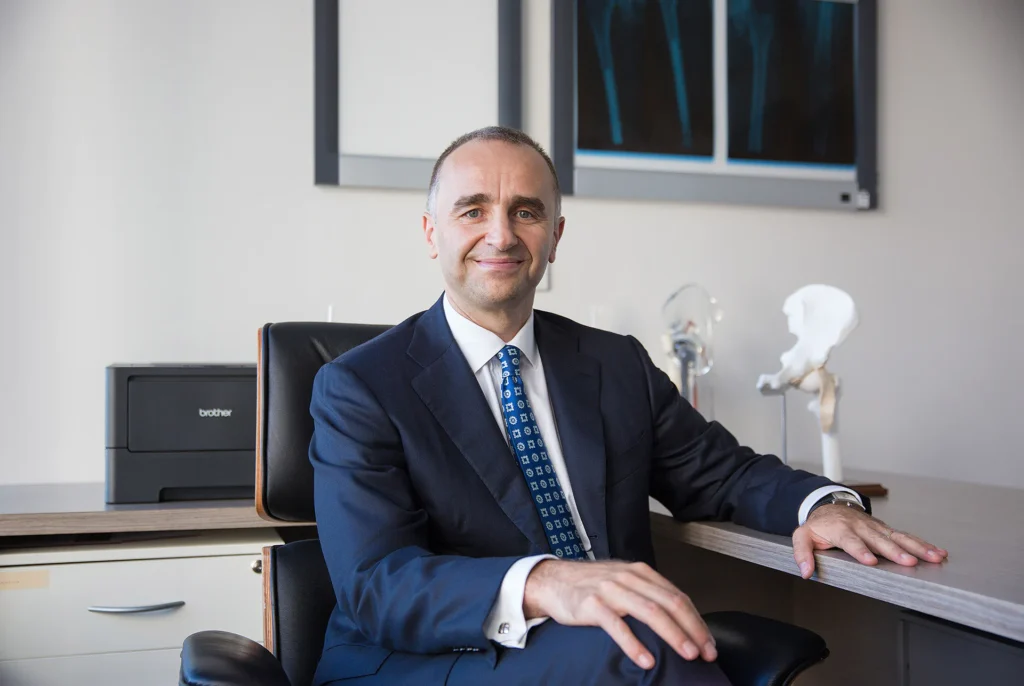
Dr Razvan Stoita is a Sydney based orthopaedic surgeon performing a range of hip procedures, including hip arthroscopy, labral repair, and total hip replacement. Each treatment plan is tailored to the individual, considering factors such as age, activity level, and long-term joint health. A careful, patient-focused approach is taken to ensure optimal outcomes, with attention to surgical precision, rehabilitation, and a smooth return to daily life.
Dr Stoita consults at Hurstville Private Hospital, Macquarie University Hospital (North Ryde), and Goulburn.
TREATING
Arthritis and Joint
TREATING
Soft Tissue and Tendon
TREATING
Fracture
TREATING
Avascular Necrosis
TREATING
Infection
Hip resurfacing is an alternative to conventional total hip replacement in which the femoral head is reshaped and capped with a prosthesis rather than removed. The acetabulum is resurfaced with a separate cup that articulates with the femoral cap. Because the femoral head and neck are preserved, resurfacing maintains the natural biomechanics of the hip, conserves bone stock for any future revision, and can allow a remarkable return to high-impact activities in selected patients.
Traditional metal-on-metal hip resurfacing was introduced in the 1990s and gained widespread popularity in young, active patients because of its excellent functional results. However, concerns about metal ion release, adverse local tissue reactions (pseudotumours) and higher revision rates, particularly in women and patients with smaller femoral heads, led to a significant decline in its use.
ReCerf is a modern ceramic-on-ceramic hip resurfacing implant, developed specifically to address the limitations of metal-on-metal resurfacing while preserving the functional advantages of the resurfacing concept. It uses a fourth-generation alumina-matrix composite ceramic (BIOLOX® delta) for both the femoral cap and the acetabular cup, eliminating metal ions from the bearing surfaces.
ReCerf is one of the most significant advances in hip resurfacing and represents a true evolution of the procedure.
Piriformis syndrome is an uncommon cause of buttock and posterior thigh pain, caused by irritation or compression of the sciatic nerve by the piriformis muscle. Surgical release of the piriformis and decompression of the sciatic nerve is reserved for the small group of patients with severe, disabling symptoms that have failed prolonged non-operative treatment, and in whom other causes of sciatic nerve pain have been excluded.
Typically 1-2 hours for a standard primary hip replacement, though total time in the operating room (including anaesthesia setup and positioning) often runs a bit longer than that. Patients are usually in theatre for around 2–3 hours in total. Robotic-assisted and complex revision cases can take longer due to additional imaging-based planning and precision steps during the procedure.
The direct anterior approach is a muscle-sparing technique for hip replacement, where the surgeon accesses the hip joint through a natural interval between muscles rather than cutting through them. It’s one of several surgical approaches Dr Stoita uses, selected based on individual anatomy and clinical suitability. Dr Stoita will discuss which approach is right for you at consultation.
A significant cause of hip pain in women over 50 is greater trochanteric pain syndrome, often related to tears of the gluteus medius and minimus tendons, sometimes called the “rotator cuff of the hip.” These tendons are critical for hip stability during walking. When 6–12 months of physiotherapy, activity modification and injections don’t resolve symptoms, surgical repair can provide durable pain relief.
Please note, all surgical procedures carry risks. Please book an appointment with Dr Stoita to find out what the best treatment option is for you.
Robotic-assisted surgery is an important advancement in modern joint replacement. Combined with the concept of functional alignment, it allows the procedure to be tailored to each patient’s individual anatomy rather than following a one-size-fits-all approach. Dr Stoita routinely uses computerised and robotic surgical techniques for hip and knee replacement, and was NSW’s first surgeon to perform robotic total knee replacement using the NAVIO system’s 3D mapping technology.
Hip arthritis usually develops over time rather than from a single cause. The most common reason is gradual wear of the joint cartilage with age. However, many people develop it earlier due to subtle issues with the shape of the hip, when the ball and socket don’t fit perfectly, it creates uneven pressure that slowly damages the joint. Previous injuries, such as fractures or dislocations, can also speed up this process. In some cases, genetics, inflammation, or increased load on the joint (including higher body weight or repetitive stress) contribute.
Modern hip joint replacements are designed to last a very long time. Advances in materials and bearing surfaces mean hip replacements can now be performed in younger patients with good long-term durability. Registry data shows most implants remain in place for well over 20 years, provided no complications such as infection, fracture around the implant, or dislocation occur.